
Track Fisher Supervision Records
Status can change after the first search. Keep the retrieval date, exact agency label, identifiers used, and a citation for each public result. If a court file and TDCJ record appear inconsistent, do not blend them. The court controls its judgment, TDCJ controls state custody and parole status, and the supervising office controls its current assignment. A later revocation action, warrant, or corrected sentence can make an older release entry incomplete.
Ask for a named record. A TDCJ inquiry can seek public release, supervision, or discharge fields tied to a TDCJ or SID number. A clerk request can identify the cause number and seek the judgment, conditions, modification, revocation, or termination order. This method keeps physical release, supervision, and final discharge in sequence.
Fisher County Parole Versus Probation
Texas divides supervision by legal source. The Texas Board of Pardons and Paroles makes parole and mandatory-supervision decisions. The TDCJ Parole Division then supervises people released from a state prison or state jail. Fisher County adult probation is administered through the 32nd Judicial District Community Supervision and Corrections Department, often called CSCD. It carries out a judge's community-supervision order. A probationer may never have entered TDCJ custody.
That split controls the search. A TDCJ detail record or TDCJ IVSS entry can show state custody, parole, mandatory supervision, or a later discharge. A Fisher County misdemeanor or felony judgment can show probation terms. The local CSCD can confirm information it is permitted to release. Neither office should be asked to certify the other system.
| Issue | Parole | Probation |
|---|---|---|
| Legal source | Release decision after TDCJ confinement | County or district court judgment |
| Supervising body | TDCJ Parole Division | 32nd Judicial District CSCD |
| First public record | TDCJ offender details and IVSS | County or District Clerk case file |
| Fisher-area office | Abilene District Parole Office | Roby or Sweetwater probation office |
| How it ends | TDCJ discharge or other lawful termination | Court completion or termination order |
- Parole
- Conditional release from prison while a sentence remains active.
- Probation
- A court-ordered community sentence, also called community supervision.
- Mandatory supervision
- A Texas release mechanism governed by sentence credits and statutory eligibility.
- Discharge
- The responsible authority's recorded end of the sentence or supervision term.
Check Fisher County Post-Release Status
Begin with identity, not an assumed status. Names can match. A date of birth, SID number, TDCJ number, and Fisher County cause number help keep records from different people separate. Then determine whether the case produced a county judgment or a TDCJ commitment. The Fisher County released-inmate search path explains how the jail, court, and corrections records fit together.
- Search the Fisher County court record. Use the County Clerk for Class A or B misdemeanor cases and the District Clerk for felony matters. Read the judgment and later orders.
- If the sentence includes TDCJ, search the TDCJ offender database by TDCJ number or by exact name and identifying details.
- Open the correct record and note custody status, actual or projected release information, parole fields, and sentence dates. A favorable parole vote is not proof of physical release.
- Use the TDCJ IVSS one-person search for custody or parole and mandatory-supervision information. Save the source and retrieval time.
- Confirm the assigned office through the TDCJ county cross-reference or the Fisher probation contacts. Specialized caseloads and moves can change reporting sites.
- For an authoritative end point, obtain the discharge entry or court termination order. Physical release and completed supervision are different events.
A parole approval, projected date, or closed Fisher jail booking does not prove that a person has entered the community. Holds and transfer processing can keep custody continuous.
Fisher Probation Uses Two Offices
The local geography is unusually important. Fisher County's adult-probation page lists a Roby office at 112 North Concho, Room 102, but the officer is present there on Wednesdays. Sweetwater provides the continuing office alternative. This is local probation under the 32nd Judicial District. It is not a branch of TDCJ parole.
32nd Judicial District CSCD
Roby: 112 N. Concho, Room 102, Roby, TX 79543
Schedule: Wednesdays
Phone: 325-776-3275
Sweetwater: 325-235-2608
Fax: 325-235-8571
Verify the judgment through the appropriate clerk before calling. The County Clerk's official records cover Class A and B misdemeanors. Felony files belong to the District Clerk. A person may be free on bond with a pending case and have no probation order at all. Conversely, probation can continue after a brief jail sanction. The court docket supplies the legal basis, while CSCD handles current supervision.
Public access has limits. Reporting schedules, private addresses, treatment details, and safety-sensitive facts may not be disclosed. Ask for the public status or the proper records route rather than confidential case-management information.
Fisher Parole Maps to Abilene
State parole follows a different map. TDCJ's county assignment list sends Fisher County parole matters to the Abilene District Parole Office in Region V. The office serves people released from TDCJ on parole or mandatory supervision. It does not confirm a local bond release, county-jail transfer, or probation sentence.
The official Region V directory is the source for the office details shown here. Staff should still confirm the reporting office for one person because residence, specialized supervision, or reassignment can change the field location.
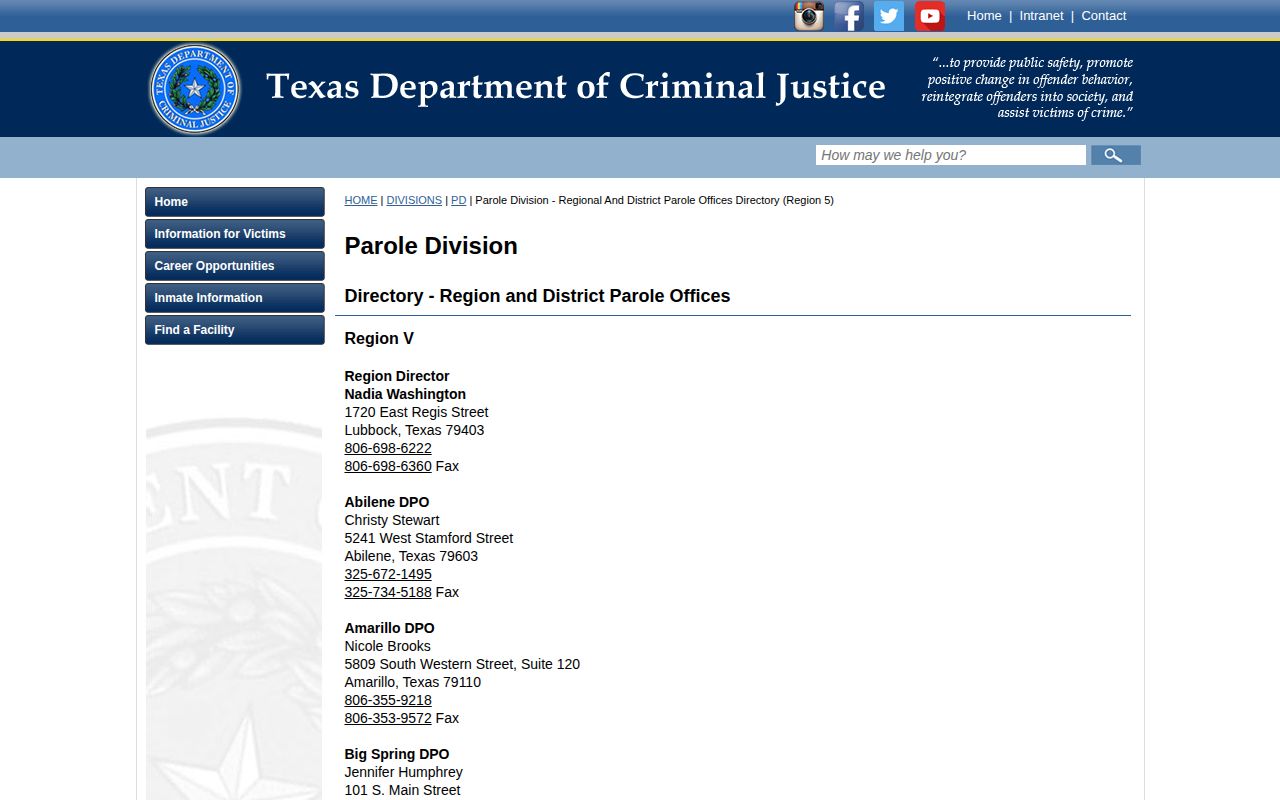
The directory confirms the office channel, but it does not substitute for the individual's TDCJ record.
Abilene District Parole Office
Region V
5241 W. Stamford Street
Abilene, TX 79603
Phone: 325-672-1495
Fax: 325-734-5188
Fisher Release Conditions and Violations
Conditions depend on the actual order. Common duties can involve reporting, approved residence, fees, programs, travel limits, or compliance with special terms. The judgment or release certificate controls. A general web summary cannot establish an individual's current conditions.
A violation allegation does not automatically equal a new conviction or completed revocation. Parole matters may involve a warrant, investigation, administrative hearing, and Board action. Probation violations return to the sentencing court. An absconder is a person alleged to have stopped reporting or whose location is unknown under supervision. That label should not be treated as a finding of a new offense.
No general Fisher County parole or probation absconder list was found. TDCJ exposes a limited Sex Offender Absconder Information Search, and the Texas DPS registry applies only to people with a registration duty. Absence from that registry says nothing about an ordinary parole or probation case. For urgent warrant questions, use the responsible law-enforcement or supervising authority.
Notifications After Fisher County Release
Texas now uses two notification systems. Texas IVSS-Counties concerns participating county jail and court events. TDCJ IVSS concerns people in TDCJ custody or on parole or mandatory supervision. Fisher Sheriff's page still points to legacy VINELink, but the Attorney General reports that county VINE moved to IVSS-Counties in September 2025.
Notifications can help track an event, yet they are not certified supervision records. Delivery can lag, and a county event may be reported under the out-of-county boarding agency because Fisher's jail is closed. For state supervision, select the correct TDCJ record, subscribe through IVSS, and preserve the exact event wording. Then compare it with the offender detail and the field office.
The Fisher County VINE inmate check separates the current county portal, TDCJ IVSS, and the old PIN workflow. It also explains why no single alert proves sentence discharge.
When Fisher County Supervision Ends
Release from a building and discharge from a sentence are separate milestones. A parolee can live outside prison while TDCJ supervision and the sentence remain active. A probationer can complete a local term without ever entering state prison. Someone who serves a county-jail sentence may leave with no supervision at all.
For parole or mandatory supervision, look for an explicit TDCJ discharge or other final status. If the online record is unclear, use TDCJ's published email or Public Information Act route with exact identifiers. For probation, obtain the court's completion or termination order from the clerk. Do not infer completion from the passage of an expected date.
Texas Government Code Chapter 508 governs parole and mandatory supervision, but eligibility rules do not themselves prove discharge. County judgments and orders control probation. Keep the release timestamp, supervision record, and final discharge document as separate records. Together they show when confinement ended, whether oversight followed, and when that oversight lawfully stopped.