
Fisher Projected and Actual Release
A projected release date estimates when a sentenced person may leave confinement based on the rules and credits then in the record. It is not the exit transaction. TDCJ also uses a later “Scheduled Release date” and “Scheduled Release location” after approval and processing. Even that date can change. The actual release or transfer entry is the retrospective fact.
A pretrial Fisher County detainee usually has no sentence-based date to calculate. Bond, a court order, dismissal, a plea, or transfer may change custody. Since Fisher's jail is closed, the person may be held in a boarding jail outside the county. Ask Fisher Sheriff to name the physical custodian before seeking a date.
Find Fisher County Release Dates
Classify custody first. TDCJ is correct for someone received into a Texas state prison or state jail. It is not the source for a person who posted bond from a county booking. A county sentence belongs with the court, Fisher Sheriff, and the actual boarding jail.
- Check the Fisher County court file to learn whether the person is pretrial, serving a county sentence, or committed to TDCJ.
- For TDCJ custody, open the official offender search and use the TDCJ number when known. Otherwise compare full name and available identity details.
- Open the matching record only after checking the offense county, sentence, identifiers, and dates.
- Record current status, facility, Projected Release Date, maximum sentence date, parole eligibility, and the retrieval date.
- For county time, ask Fisher Sheriff and the boarding jail for the sentence-credit calculation and controlling court order.
- After the expected day, confirm the actual release or transfer event rather than repeating the projection.
The full Fisher County released-inmate search covers court, jail, and transfer records when the custody type is uncertain.
The official TDCJ search is shown below.
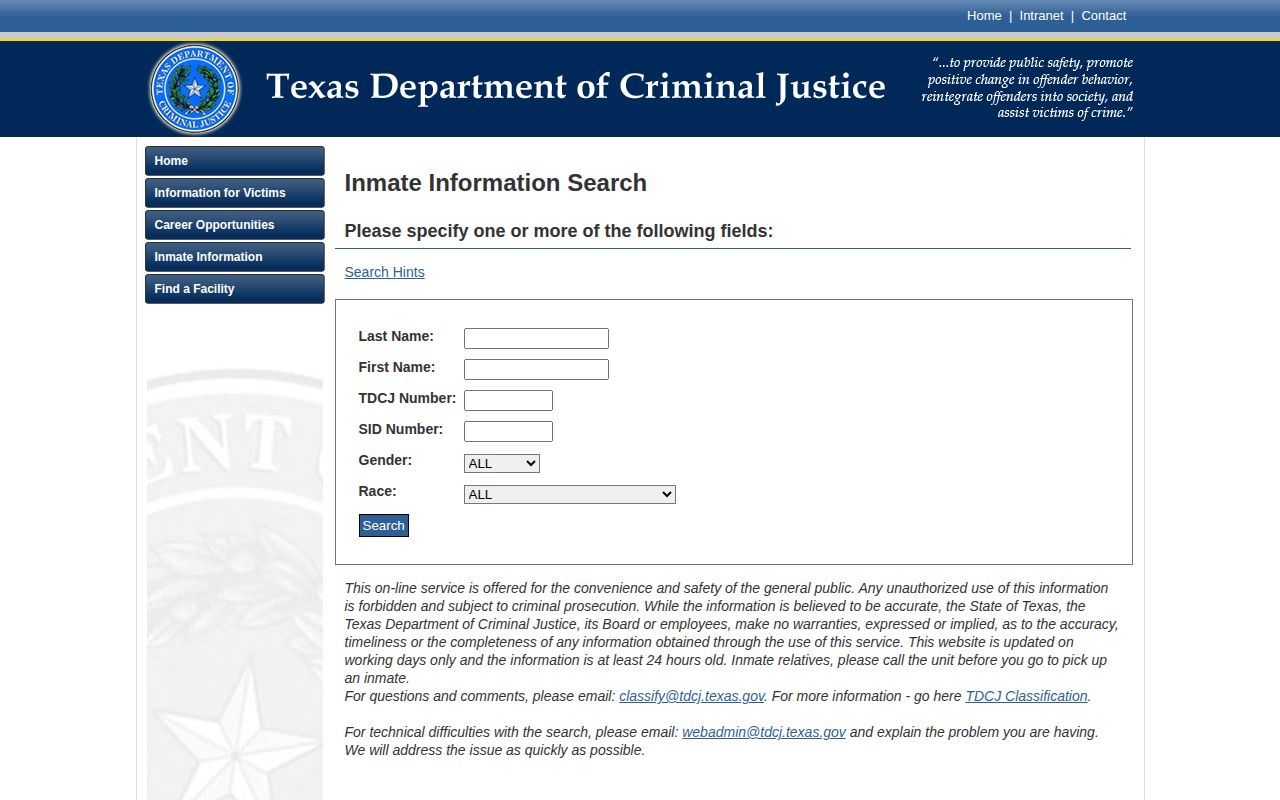
Save the date of access because calculations and status fields can change.
Texas Good Time for Fisher Releases
Texas Government Code Chapter 498 governs TDCJ good-conduct time. Section 498.003 makes it a privilege rather than a right and links awards to classification and qualifying participation. The credit affects parole or mandatory-supervision eligibility. It does not shorten the sentence imposed by the court. Misconduct, classification changes, and corrected records can alter credits.
Texas has no blanket rule requiring every prisoner to serve 85 percent. The calculation depends on the offense, offense date, sentence, and special category. Under the residual rule in Government Code Section 508.145(f), calendar time plus good time may reach one-fourth of the sentence or fifteen years, whichever is less. Serious offenses described by subsection (d) use actual calendar time, without good time, equal to one-half of the sentence or thirty years, whichever is less, subject to minimums and other rules. Some people have no parole eligibility. Eligibility only permits review.
Why Fisher Release Dates Move
The maximum sentence date is not always the expected door-out date. A parole eligibility date is also distinct. It marks when review may begin under the governing category. Record each label exactly, since one loose release date hides why the fields differ.
A date can move in either direction as agencies correct time, apply rules, and act on the case. A favorable parole vote is not a completed release. Review and Release Processing can still examine plans, warrants, detainers, conditions, and certificates.
| Factor | Possible effect |
|---|---|
| Jail credit correction | Adds or removes credited calendar time |
| Good-time classification | Changes eligibility credit based on TDCJ records |
| Discipline | Can forfeit credit or change classification |
| New sentence or detainer | May block release or transfer custody elsewhere |
| Parole panel action | May approve, deny, defer, or add program conditions |
| Clerical correction | Changes a field when the underlying data were wrong |
Sentence stacking and concurrency also matter. Consecutive sentences run one after another, while concurrent terms overlap. The judgment and TDCJ calculation, not a web calculator, control the result.
Confirm a Fisher County Release
For TDCJ, compare the public detail record with TDCJ IVSS. The status may distinguish prison custody, parole, mandatory supervision, and discharge. Parole or mandatory supervision means the person left confinement but remains supervised. Discharge ends the sentence or supervision obligation reflected by the agency. If the online result is unclear, TDCJ also accepts inmate-information requests by email and telephone.
For a Fisher county sentence, request the permanent jail-register entry and release or transfer sheet. The register should preserve the release or transfer date, while the fuller incarceration file can include booking-out forms, transport records, and court orders. Since the person may have been boarded elsewhere, ask for both Fisher's record and the receiving jail's exit record.
A pending event can be followed through the Fisher County VINE inmate check, now routed through Texas IVSS systems. An alert is not certified proof and may arrive after the event.
Texas Fisher Release Date Quirks
TDCJ's named Projected Release Date has a special mandatory-supervision history. For an eligible offense before September 1, 1996, the projection can mark when calendar time plus good time equals the sentence if parole has not occurred. For an eligible offense on or after that date, the same equation is subject to Board approval under discretionary mandatory supervision.
If the Board denies discretionary mandatory supervision, TDCJ may recalculate the projected date to maximum expiration or discharge. A later approval can move it earlier for release processing. If mandatory supervision is not legally available, the projection generally equals maximum expiration unless parole occurs sooner. This is why a copied date without its offense-date context can mislead.
Scheduled Release date and location are later fields. They can appear after approval, but processing can still change them without notice. A generic sentence calculator cannot account for these record-specific decisions.
Fisher County Jail Good Time
County-jail credit follows a different law. Texas Code of Criminal Procedure Article 42.032 allows a sheriff to grant up to one day of commutation for each day actually served for good conduct when no misconduct charge is sustained. That county authority is not TDCJ's state-prison formula.
Fisher's boarding arrangement creates a practical question: which sheriff maintains the classification and calculation, and what order controls? The reviewed sources do not answer it. Request the written calculation from Fisher Sheriff and the receiving jail rather than importing another county's policy. Include the cause number, sentence dates, jail-credit finding, and the period actually held.
- Projected release
- An agency estimate based on the record and rules then in effect.
- Scheduled release
- A later planned date and place after approval and processing.
- Actual release
- The completed physical-custody transaction.
- Detainer
- A request or hold that may cause transfer to another custodian.
Fisher Parole Dates and Decisions
Parole eligibility is the point at which review may occur. It is not a release date. The Texas Board of Pardons and Paroles can approve, deny, defer, require a program, or later withdraw approval when new information appears. Ordinary parole review is based on file voting rather than a public person-by-person hearing. A Board open meeting is not the prisoner's release calendar.
After favorable action, look for Scheduled Release date and location in the TDCJ record. Review and Release Processing still checks eligibility, release plans, conditions, warrants, detainers, and certificates. Then check the actual status after the planned day. TDCJ IVSS and the public offender detail can show different parts of the sequence. The Abilene District Parole Office can address field supervision for Fisher County after release, but it does not replace the prison's exit transaction.
A discretionary mandatory-supervision decision also affects the calculation. A denial may move the Projected Release Date to maximum expiration. Later approval can move it forward again. Record the Board decision date, the projection retrieval date, and the final status separately so the history remains clear.
Fisher Court Date Evidence
Fisher County court records explain why custody may end without supplying the exact door-out time. The County Clerk covers Class A and B misdemeanor files. The District Clerk holds felony and district-court records. Useful documents include the bond, plea, judgment, sentence, dismissal, commitment, jail-credit finding, revocation order, and release order.
A bond gives legal authority for pretrial release but can precede the actual exit. A “time served” judgment may explain the result while the sheriff record supplies the completed timestamp. A commitment to TDCJ explains why a Fisher booking ended even though the person remained confined. When dates disagree, do not merge them. Label the court date, jail transaction, and TDCJ status according to the event each source records.
Names are not enough to join records. Compare cause number, date of birth, SID or TDCJ number, offense, conviction county, and sentence dates. Search aliases as a technique, but do not treat an alias as confirmed identity until the agency record links it.
Fisher Actual Release Records
The Texas State Library's Local Schedule PS gives the county record a longer life than any web display. The county jail register, PS4200-06, is permanent and minimally includes name, gender, intake number, reason for confinement, and release or transfer date. Prisoner-incarceration files under PS4200-10 include commitment, transport, transfer and release material, booking-in and booking-out forms, and court release orders. Their minimum retention is release or transfer plus two years.
Retention does not make every field public. Confidential and protected content may be redacted. Still, the permanent register is the key fallback when no Fisher roster exists. Ask for the exact field that distinguishes community release from transfer and for the destination or receiving agency if recorded and public. Because Fisher boards inmates outside the county, the receiving jail may hold a second exit record.
A focused request should name the person, date range, cause or intake number, and the records sought. Ask for electronic copies of the register entry, release or transfer sheet, court authorization, sentence-credit calculation, and receiving-agency field. Agencies need not answer a broad question or create a new calculation. Request the existing record that contains it.
Public Record Search
Sponsored Results